
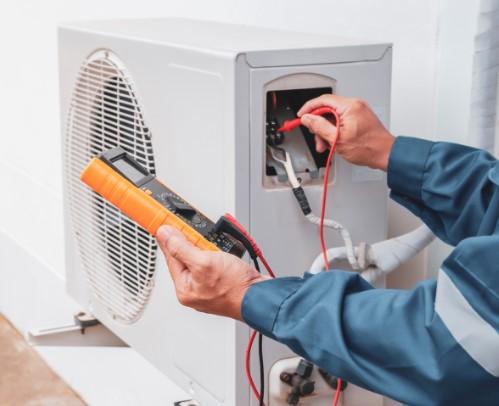
A bad AC capacitor usually shows itself in 4 ways: the outdoor unit hums but doesn’t start, the outdoor fan won’t spin, the AC blows warm air, or the system clicks on and off. It’s a common fault in Abu Dhabi because heat wears capacitors down fast. It’s a small part, but it’s urgent: run the AC on a failing capacitor for long and you can burn out the compressor, which is a far bigger job for any AC maintenance team in Abu Dhabi.
At Special Air Condition General Maintenance (SACGM), we see capacitor failures every single summer. Homeowners often book AC repair thinking the whole unit is dead, when the real problem is a part about the size of a soda can.
Below you’ll find the warning signs, why capacitors fail here, what you can safely check yourself, and when to call a professional air condition repair service instead of guessing.
For Arabic-speaking households, our team also offers خدمة إصلاح مكيفات في أبو ظبي with the same diagnostic process explained in Arabic.
So if your split or central unit has started acting strange during a 46°C afternoon, the capacitor is one of the first things worth checking. And the good news is that the fix is usually quick once someone qualified confirms it.
What is an AC capacitor?
An AC capacitor is an electrical component that stores and releases energy to give the compressor and fan motors the push they need to start and keep running. Think of it as a battery that discharges in a quick burst.
Most split and package units have one of two types:
- Run capacitor: keeps the compressor and fan motor running at a steady, efficient speed.
- Start capacitor: gives the compressor a strong kick at startup, then drops out of the circuit.
Many modern outdoor units use a dual run capacitor, which is one cylinder serving both the compressor and the condenser fan. You’ll see 3 terminals on top marked C (common), HERM (compressor) and FAN.
Capacitors are rated in microfarads (µF or MFD) and voltage. A typical outdoor unit might use something like a 35/5 µF dual capacitor rated at 440V. If the measured value drops more than about 6% below the label, the part is weak.
What are the signs of a bad AC capacitor?
Here are the symptoms we find most often during service visits across Abu Dhabi, roughly in order of how common they are.
1. The outdoor unit hums but nothing turns
This is the classic one. The compressor or fan motor gets power, but there’s no starting push. So it sits there humming. If you hear a steady buzz from the outdoor unit and the fan isn’t moving, switch the AC off.
2. The outdoor fan doesn’t spin
The indoor unit blows air, but the fan on the outdoor unit stays still. Sometimes the fan will start if it’s nudged with a stick. That trick tells you the motor is fine and the capacitor is weak (please don’t try it yourself; more on safety below).
3. Warm or barely cool air
If the compressor can’t start, refrigerant doesn’t circulate. The indoor fan keeps blowing room-temperature air, and you’ll notice it within minutes.
4. The AC starts, stops, and clicks
A failing capacitor may let the compressor start for a few seconds, then trip on overload. You hear a click, silence, and another click a few minutes later.
5. A bulging or leaking capacitor
When a technician opens the access panel, a bad capacitor often has a domed top or oily residue. That’s a sure sign it’s finished.
6. Higher electricity bills
A weak run capacitor makes motors draw more current. It’s subtle, but it can push up your monthly ADDC bill during peak summer.
Is a bad capacitor minor or urgent?
It’s urgent. The part itself is simple to replace, but the damage it causes if ignored isn’t.
| Situation | Risk level | What to do |
|---|---|---|
| Fan spins slowly, cooling slightly weaker | Moderate | Book a check within a few days |
| Outdoor unit hums, nothing starts | High | Switch off now and call a technician |
| Unit clicks on and off repeatedly | High | Switch off; repeated tripping stresses the compressor |
| Burning smell or swollen capacitor | Urgent | Turn off at the breaker and get professional help |
A compressor that keeps trying to start without help overheats. Do that for a few days and the windings can fail. At that point you’re looking at a compressor replacement, or even a new unit.
Why do AC capacitors fail so often in Abu Dhabi?
Capacitors are sensitive to heat, and our outdoor units live on rooftops and balconies that bake all day. A few local factors make it worse:
- Extreme ambient heat: outdoor units often sit in direct sun where the cabinet temperature climbs past 60°C.
- Long running hours: many homes run AC 18 to 24 hours a day from May to October.
- Voltage fluctuations: power dips and surges, especially in older buildings, stress the dielectric inside.
- Dust and sand: a dirty condenser coil makes the unit work harder and run hotter.
- Low-quality replacements: cheap, unbranded capacitors with the wrong rating fail within months.
We think heat is the biggest factor. A capacitor that might last 10 years in a mild climate often lasts 3 to 5 years here.
Myths about AC capacitors
Myth: “If the indoor unit works, the AC is fine.”
The indoor fan runs on a separate circuit. Your indoor unit can blow air all day while the outdoor capacitor is dead.
Myth: “Any capacitor that fits will do.”
The µF rating and voltage must match the manufacturer’s spec. A wrong value can overheat the motor or make it run poorly.
Myth: “Turning the AC off and on again fixes it.”
Restarting may get the compressor going once or twice, but each hard start strains the motor more. It hides the problem.
Myth: “Low gas is always the reason for warm air.”
Low refrigerant is one cause, but we find capacitor faults behind a lot of “no cooling” calls. Adding gas to a system with a bad capacitor wastes money and fixes nothing.
Can I check my AC capacitor myself?
You can safely look for the outside signs. You shouldn’t open the panel or touch the capacitor.
Safety warning: a capacitor holds a charge even after the AC is switched off. Touching the terminals can give you a serious shock. Testing and discharging capacitors is a job for trained technicians who follow Abu Dhabi Department of Municipalities and Transport (DMT) and UAE electrical safety standards.
Here’s what a homeowner can safely do:
- Switch the AC to cooling mode and set it a few degrees below room temperature.
- Stand near the outdoor unit (without touching it) and listen for humming, clicking, or silence.
- Check whether the outdoor fan blades are spinning.
- Feel the air from the indoor unit after 5 to 10 minutes. Is it cool?
- Check your breaker panel for a tripped AC breaker.
- If you notice humming with no fan movement, switch the AC off and call for service.
How does a technician test and replace a capacitor?
A proper diagnosis takes a short time when it’s done step by step. This is roughly how our certified technicians work:
- Isolate power at the breaker and the outdoor isolator switch.
- Discharge the capacitor safely with an insulated resistor tool.
- Inspect visually for bulging, leaks, or burnt terminals.
- Measure capacitance with a multimeter and compare it to the label rating.
- Check related parts such as the contactor, wiring and fan motor, because they often fail together.
- Fit a matched replacement with the correct µF and voltage rating.
- Test the system by checking amperage, fan speed and supply air temperature.
That last step matters. A new capacitor on a motor that’s already damaged won’t hold for long, so we always confirm the motors are healthy before we leave.
Capacitor problem or something else?
Several AC faults look alike. This quick comparison helps you describe the issue when you call.
| Symptom | Bad capacitor | Low refrigerant | Faulty contactor |
|---|---|---|---|
| Outdoor unit hums | Common | Rare | Sometimes |
| Fan not spinning | Common | No | Yes, if no power |
| Ice on pipes | No | Common | No |
| Clicking on and off | Common | Sometimes | Common |
A trained eye and a meter settle it in minutes. That’s why we never recommend replacing parts on a hunch.
How can you make your AC capacitor last longer?
- Book regular AC maintenance Abu Dhabi visits before and during summer.
- Keep the outdoor condenser coil clean so the unit runs cooler.
- Shade the outdoor unit if possible, while leaving enough airflow space.
- Use a voltage stabiliser in buildings with frequent power fluctuations.
- Insist on branded capacitors with the correct rating.
- Don’t restart the AC repeatedly when it’s struggling.
Tip: ask your technician to write the capacitor rating and replacement date inside the panel cover. Next time, the job is quicker.
What does a capacitor failure look like in real homes?
Two calls from last summer show how differently it can play out.
A villa owner in Khalifa City noticed the upstairs bedroom AC blowing air that felt “a bit off” for about a week. By the time we arrived, the compressor was tripping every few minutes. The run capacitor had dropped to roughly half its rated value. We replaced it, checked the compressor amps, and the unit was back to normal the same afternoon.
A small office in Musaffah wasn’t as lucky. Their outdoor unit hummed for nearly 2 weeks before anyone called. The capacitor was swollen, and the compressor windings had already overheated. That repair took far longer and cost far more than a capacitor swap would have.
The lesson is simple: a humming outdoor unit is a warning, and a quick call early saves a lot.
Getting a bad capacitor fixed in Abu Dhabi
If you’re searching for reliable AC Repair in Abu Dhabi, SACGM has been doing this work for over 20 years. We help homeowners, property managers and businesses with certified technicians who handle all major brands, models and types of household equipment, from split units to central systems.
Our team carries common capacitor ratings, so many repairs are finished during the first visit. A diagnostic site visit has a standard charge of 100 AED, and we explain what we find before any repair starts. No surprises.
You can call or WhatsApp us on +971523476261, email mozammalhoque2020@gmail.com, or visit our workshop at Musaffah M/6 Building No: 78 Sector No: 06, Abu Dhabi. Our site, specialairconditiongeneralmaintenance.com, also lists our HVAC Repair Abu Dhabi and Air Conditioner Service Abu Dhabi options.
And if you manage several units, we can set up a maintenance schedule so capacitor wear gets caught early, before a breakdown on the hottest day of July.
Frequently asked questions
How long does an AC capacitor last in Abu Dhabi?
Most last around 3 to 5 years here because of extreme heat and long running hours. Quality, voltage stability and how clean the outdoor unit stays all affect lifespan.
Can an AC run without a capacitor?
No. Without a working capacitor the compressor and outdoor fan can’t start properly. The indoor fan may still run, but you won’t get cool air, and the compressor can overheat trying to start.
Is it dangerous to replace an AC capacitor myself?
Yes. Capacitors store a charge even when power is off and can cause a serious electric shock. Replacement should be done by a certified technician using proper discharge and testing tools.
Will a bad capacitor damage my compressor?
It can. A compressor that repeatedly struggles to start overheats, and over time the motor windings can fail. Replacing a weak capacitor early protects the most expensive part of your AC.
How quickly can a bad capacitor be fixed?
Once it’s confirmed with a meter, a replacement usually takes less than an hour. Most repairs can be completed on the same visit if the correct rated part is available.
Conclusion
A humming outdoor unit, a still fan, or warm air are strong signs of a bad AC capacitor. Switch the system off early to protect your compressor. Then let a certified technician test it properly and fit the right part.
